Rajput Caste and Community: A High-Level Overview
Rajput Community, the de facto ruling class of India. Historical overview, clan structure and regional diversity.
-
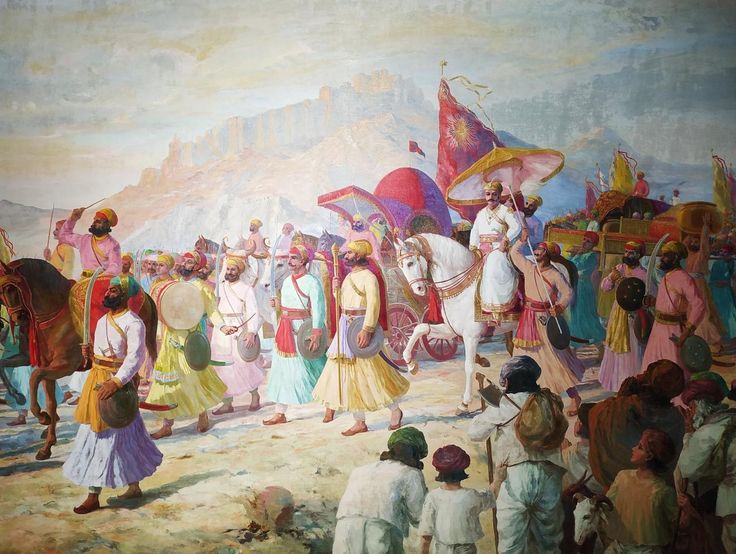
Rao Bika
of Marwar kingdom with his army, marching towards “Jangla Pradesh(modern day Bikaner) - Image Credits:- Rajyashree BikanerRajput / Rajaputra
Rajput (from Sanskrit raja-putra, “son of a king”), is an erstwhhile ruling and landowning community, mostly populated in and around Northern, Western, and Central India. They belong to the Kshatriya varna within broader Hindu community and are usually referred to as Northern Kshatriyas.
The community inherits a clan based system, having various sub-clans and each more or less associted with their historical seat of ruling and admisnistration.
They are found in significant numbers in the following Indian states:
- Rajasthan
- Gujarat
- Madhya Pradesh
- Haryana
- Jammu
- Punjab
- Uttar Pradesh
- Himachal Pradesh
- Uttarakhand
- Bihar
- Maharashtra
and also parts of Nepal and Pakistan.
Medieaval India saw the rise of these patrilenial clans and their associated kingdoms throughout western, central, and northern india. The most noted and long lasting of these were the Kingdom of Mewar, Kingdom of Marwar and the Kingdom of Amber(Jaipur).
Etymology
Rājaputra
The term Rājaputra (Sanskrit: राजपुत्र), which literally translates to “son of a king,” appears in several ancient Hindu texts, including the Rigveda, Ramayana, and Mahabharata.
Historian Sabita Singh notes that the word conveyed the meaning beyond its literal sense in a 7th century manuscript. It is used in the Bakhshali manuscript (from the North-West Frontier Province region) to refer to a mercenary soldier, in a mathemetical problem’s illustration from Sutra 53, Second example. By the 8th century, the Chachnama of Sindh employed it to describe elite horsemen.